Move 37 - the Dawn of AI
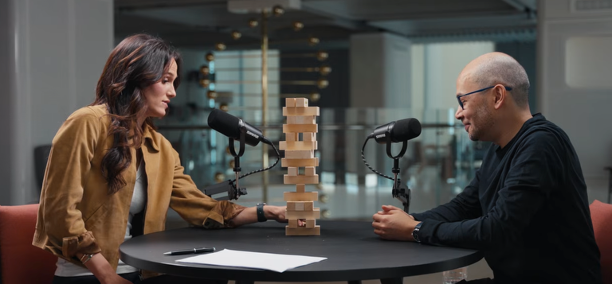
Today we shift from our usual DOAC podcast to Huge Conversations by Cleo Adams. Quite refreshing actually, and the more podcasts we see out there, it appears that the world of podcast is flourishing. Better human content, better questions, better lighting and setup. That will probably be a topic for another day.
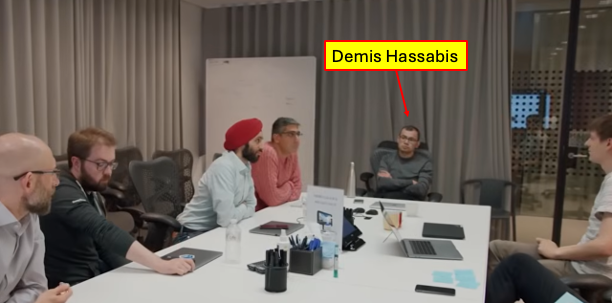
This round we are talking about Demis Hassabis - chess prodigy, turned down an offer at the age of 17 a $1m job opportunity to go to college instead, finished his PhD in cognitive neuroscience, founded company DeepMind, sold to Google for $400M pounds.. sounds like your typical IT turned billionaire. His deeply entrenched motivation - advance science and medicine through AI.
He won the Noble Prize for AlphaFold. The origin story of AlphaFold is grounded in his fascination in college with solving the biology's equivalent of the Fermat's Last Theorem - unravelling protein structure.
The nuclear pore complex is a great example of a very large protein that was hard to predict the sturcture, but AlphaFold could and did.
Imagine this: know the structure of a target, know where the drug / compound is supposed to attach, know where its not supposed to attach to prevent toxicity in all the 20,000 proteins, and can be found in few minutes. Can self-modify this process to have better binding specificity, and very last step to validate in wet lab.. all these in a couple of hours..
March 10, 2016
This is the critical moment where giving AI rules instead of data, AI has opportunities for creativity. Demis felt that was the dawn of AI moment. In the past, the programs are more like expert programs that chess grandmasters try to distill their knowledge into a system, which is basically a brute force program like DeepBlue. Work out millions of moves against the heuristics and decide what is the best.
Demis felt that was not satisfactory in the 1990s when he was an undergrad. DeepBlue can only play chess, it cannot play any other thing, not even tic-tac-toe. It is definitely not intelligent, it has zero generalisation ability, it cannot learn.
Go was kind of the final frontier of games. It’s a much more intuitive, esoteric, and artistic game, more pattern based. It has probabilities up to 10^170, which is more than the number of atoms in the world, so it’s very difficult to brute force it. It’s also hard to capture that intuitive feel of Go masters into a program.
AlphaGo started by learning all the games in the internet and then overlay with Monte Carlo tree search that allows it to discover new branches of knowledge. Move 37 was regarded as a bad move if you are a Go master, but it turned out to be the right move only after 100-200 moves later in the game, as if it was by fate placed there. It was the moment where Demis felt it was ready to turn to scientific problems like AlphaFold.
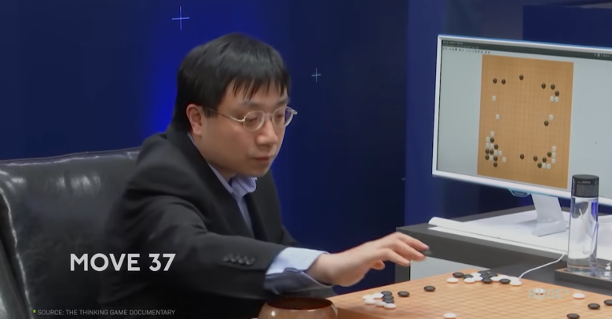
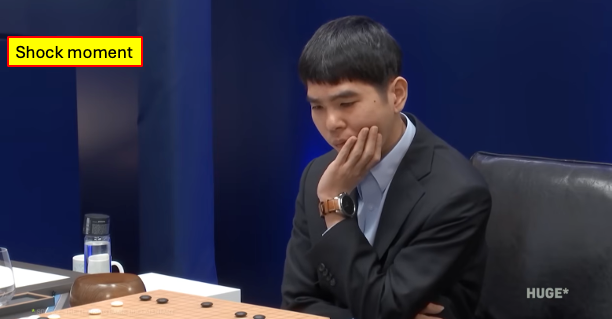
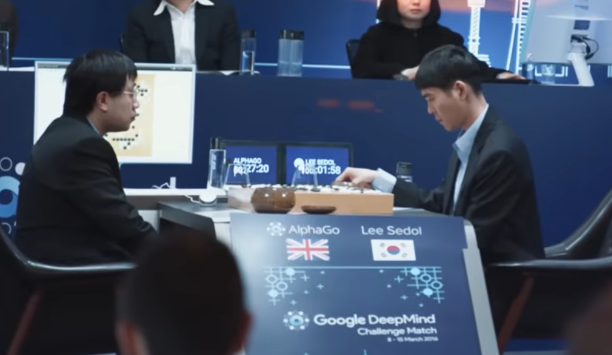
It looked wrong in the moment. It felt wrong. It violated decades of accumulated human intuition about the game. As Demis says, if you made that move, your Go Master would slap your hands. And yet, 100 moves later, it became clear—it was not just good but it was the best move. And obviously, here's the 'problem' - it's made by AlphaGo, a program.
Even if I become the number one, there is an entity that cannot be defeated - Lee Sedol, retired 18-time world Go champion
If an AI can make a move that only makes sense in the future, what exactly is it seeing?
From games to molecules
Demis didn’t build AlphaGo to win games. That was just the training ground.
The real ambition was always bigger: solve science.
And the clearest example of that ambition is AlphaFold.
For decades, biology had its own version of an unsolved riddle: how proteins fold. You could know the sequence of amino acids, but predicting the 3D structure—the thing that determines function—was painfully slow. Scientists would send in a sequence, wait days for a response. Lab work. Iteration. Days, weeks, years.
Then AlphaFold changed the pace of reality.
Today, it has predicted virtually every known protein structure. Used by over 3 million biologists. Quietly embedded in nearly every modern drug discovery pipeline.
Diseases that pharma ignored—because they weren’t profitable—suddenly had a shot. Fields like plant biology, historically underfunded, suddenly had world-class tools. Whilst only 10% of drugs had a chance through a clinical trial, this may change in the near future.
The uncomfortable truth about intelligence
Here’s the part most people miss. The real breakthrough wasn’t AlphaFold.
It spawned off many other variations, systems like AlphaZero.
- No rules.
- No human priors.
- No domain knowledge.
Just a system… learning from scratch. AlphaZero can play any game.
In chess, AlphaZero was randomly playing in the morning. By noon, it was good enough to play against Demis, and by tea time it could beat all grandmasters. By dinner time, it’s better than the world champion. It’s a generalised model of AlphaGo.
Let that sit for a second.
Not because it memorised more. But because it discovered.
And suddenly, you realise something unsettling. Maybe intelligence isn’t about knowledge. Maybe it’s about the ability to generate it.
The race we didn’t mean to start
What was supposed to be a scientific pursuit has now become something else. A race to infinite computing.
Demis admits it openly—the commercial pressure is ferocious. Every company. Every country. Especially the quiet tension between United States and China.
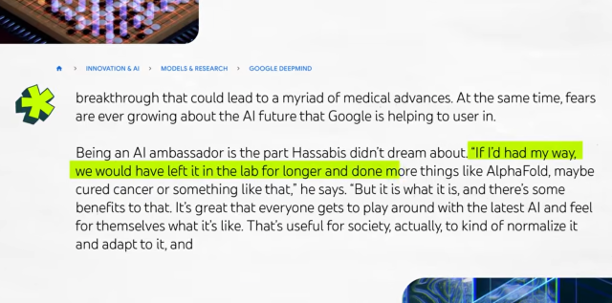
And here’s the paradox:
- The upside → AI is being democratised at unprecedented speed
- The downside → we’re deploying systems faster than we understand them
We didn’t plan for ChatGPT to go viral. It just… did. Now the world is stress-testing frontier models in real time.
Two risks. One question.
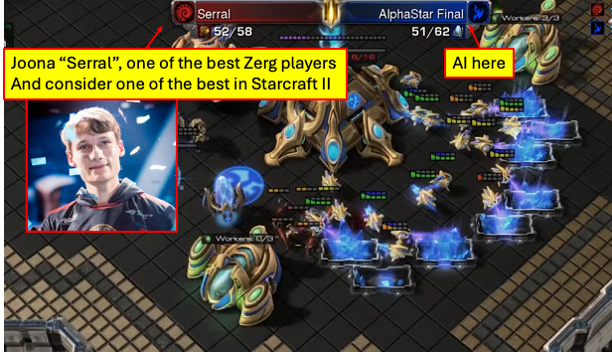
Take for example, AlphaStar, whilst it was for a war video game (my favourite Starcraft II back in my young self)… one cannot help but wonder what if AI was deployed for military and governments?
Demis is incredibly hopeful (sanguine in his own language).. because AI has done some incredible things for example saving 30% energy in data centres' cooling systems and helping to advance public health. But there are two worries that he felt the world could do more thinking about:
- Bad actors using AI (biological threats, misinformation, weaponisation)
- AI itself becoming uncontrollable as it becomes more agentic
SynthID is one answer to this, system to fight DeepFakes. All Google AI generated images and videos today have a digital watermark added to it.
Apart from that, here's some of the systems that Demis and his team is building on, spawning off AlphaGo: AlphaZero - system that can play any game.. AlphaQubit - system for quantum computing.. Torax - system for nuclear fusion questions… Alpha Tensor - system for matrix multiplication (backbone of all neural network by the way), AlphaChip - chip design.. AlphaEvolve, combining genetic algorithms with Gemini.. AlphaCode - to solve the 98% of genetics.. Gencast - weather prediction, role of simulations.. help in science that are very hard to control like social science..
But beneath both is a deeper question—the one that’s been quietly driving his life:
Is there anything the human mind can do… that a machine fundamentally cannot? Long-term planning and reasoning and some of forms of creativity.. can all these be eventually done by AI?
Are we (humans) really special?
Richard Feynman, Alan Turing are some of Demis' all time heroes. Demis is very obsessed with the big questions since young. Physics. What is time? What is consciousness? Deep mysterious play on his mind and AI helps to understand these mysteries.
Meanwhile, others like Roger Penrose, argue there might be something non-computable about consciousness. Right now, neuroscience hasn’t found it.
The world if this works
There’s a moment in the conversation where things drift into what sounds like science fiction—but not in a dismissive way. More like… a roadmap waiting for validation.
Inspired by Culture series by Iain Banks (which notably, is a hot favourite of others like Elon Musk), Demis paints a post AGI world picture if we get through it safely:
- Clean, abundant, renewable energy (SpaceX root problem is rocket fuel)
- Breakthroughs in materials (think room-temperature superconductors)
- Radical life sciences advances
- Unlocked Space Exploration
- Maxxing human flourishing
He calls it the cracking of root node problems, if you imagine a Tree of Knowledge, the branches that are stuck are the root nodes.
And all these he envisioned will happen in the near future. Not in 200 years. Possibly within 50. And for once, it didn’t feel like hype.
It felt like someone who has already seen move 37—and is just waiting for the rest of us to catch up.

Source | Huge Conversations — The Hardest Problem AI Ever Solved (Cleo Adams)
All images here were taken from Cleo's podcast. All rights reserved to her and her team.