World War III is already here
Prof Jiang delivers what feels like a 2 hour crash course in how the world actually works.
Let me say upfront: I am not a geopolitics person. I know roughly where Iran is on a map and that oil comes out of it. That is about the extent of it.
Prof Jiang has this way of explaining things where suddenly the fog lifts and you realise that the chaos you've been watching on the news is not chaos at all. It is a strategy. A very old one, with very modern tools.
So let me try to pass that clarity on.
First, a Mental Model: The Five Pillars of American Power
Before we get into Iran and Russia and what Prof Jiang thinks is an 80–90% probability of World War 3, it helps to understand how the US actually projects power. They are:
- Air supremacy — the ability to control the skies anywhere in the world.
- The US dollar — every barrel of oil priced in dollars means every country on earth needs dollars, which means they need America.
- Narrative control — the ability to define what the world believes is happening.
And when those aren't enough, there are pawns. The UK. Europe. South Korea. Japan. The entire Western Hemisphere. Countries that can be moved, pressured, or sacrificed depending on what the board requires.
The National Defence Strategy Nobody Read
The US Department of Defence — what Prof Jiang pointedly calls the Department of War — published a National Defence Strategy that is worth understanding. The gist of it: America feels it has been taken advantage of. Europeans free-rode on US defence spending while building out welfare states. China bought American technology and sold goods back at a disadvantage. The document basically says: enough.
The strategy has four moves:
- Secure the Western Hemisphere — the Monroe Doctrine, resurrected. Trump has already named the targets: Cuba, Mexico, Canada, Venezuela, Colombia, Nicaragua, Honduras.
- Reimagine alliances — tariffs, pressure, transactionalism. Allies are partners only insofar as they are useful.
- Contain China — park naval carriers along the Strait of Malacca and the first island chain (Japan, South Korea and friends). Make China feel the squeeze.
- Reindustrialise defence — go to Ford and General Motors if you have to. Stop making cars. Start making ammunition.
The goal is not to fight everyone simultaneously. It is to divide the world so others fight each other. China versus South Korea and Japan. NATO versus Russia in Ukraine. Iran versus the Gulf states. While all that is happening, America sells the weapons and the resources. The $40 trillion in US debt? It gets absorbed by a world too busy fighting to do anything else.
How Did This War With Iran Even Start?
Honestly? Nobody quite knows.
Prof Jiang suspects it is Trump. Trump thinks like a TV celebrity — generate conflict, generate congressional funding through military hype, generate attention. Whether or not that is the origin, the playbook is consistent.
There was apparently an idea floating around — Trump wanting to simply kidnap or kill Ayatollah Ali Khamenei, the Supreme Leader of Iran, and be done with it. The logic being: remove the head, the body collapses. Clean. Simple.
But that is not how Iran works. And it did not even fully work in Venezuela, which is a far simpler political structure. Iran is something else entirely.
Why Iran, and Why Now
Iran is not just a country. It is a chokepoint.
The Strait of Hormuz is 33–39 kilometres wide — if you live in Singapore, picture the distance from here to roughly Johor Bahru, except it carries 20% of the world's energy supply. The six Gulf Cooperation Council countries — Bahrain, Kuwait, Oman, Qatar, Saudi Arabia, UAE — export their energy through it. Those same countries import 80–90% of their food through it. Dubai and Doha do not grow food. They buy it. Block the strait, and you do not just hurt Iran. You hurt everyone connected to it, which is essentially the whole world.
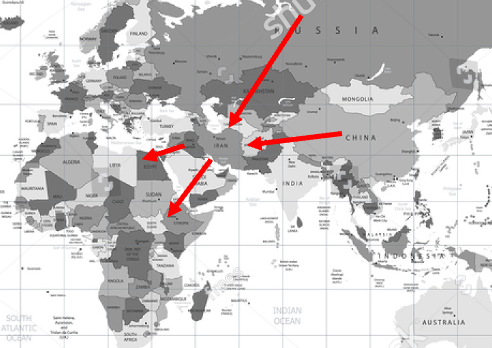
Iran also sits at the geographical chokepoint between China, Russia, and the entire southern flank — the Indian Ocean, the South China Sea, Africa. It is irreplaceable on the map.
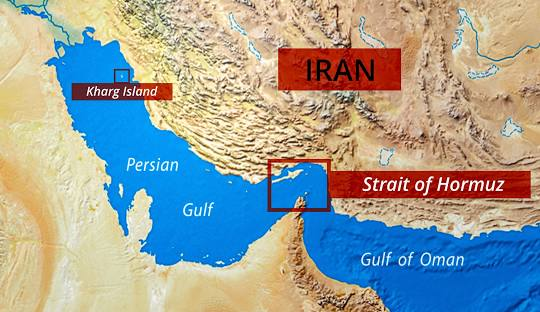
So when the US turns its attention to Iran, it is not really about nuclear weapons or the Ayatollah. It is about that strait. And about forcing the world — particularly China — to buy energy from America instead. The US has even signed legal agreements with Indonesia and Morocco to control certain straits and choke points around the world. This is a deliberate maritime strategy, not a series of coincidences.
The Topography Problem
Here is where America's plan runs into trouble.
The Iraq playbook — shock and awe, seize Baghdad, regime collapses, done — worked partly because Iraq is flat. You can drive tanks across it. The strategy is called "seize the capital, the regime falls." It worked.
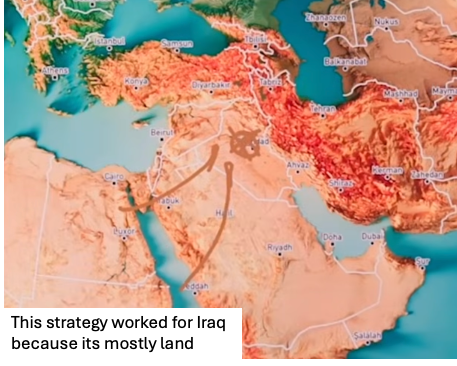
Iran is not Iraq.
Iran is a mountain fortress. 92 million people. 31 provinces, each with its own military command and leadership. Underground missile systems. The ability to strike American bases across the entire Middle East. And crucially — the Strait of Hormuz, which it can threaten to close, immediately tying any US action to the global economy and forcing every oil-importing nation to care very loudly.
The military strategy the US is actually likely to pursue — according to Prof Jiang — is not an invasion. It is three things simultaneously:
- Stir up ethnic insurgencies inside Iran — the Baloch in the southeast, the Kurds in the northwest. Turn internal divisions into active conflict.
- Naval blockade at Kharg Island — cut off 90% of Iranian oil exports going to China.
- Strangle Tehran — take out power lines, water, electricity, food supply. Make the population turn against the government.
It is not shock and awe. It is slow suffocation.
Iran's Structure Makes It Hard to Decapitate
Part of why this will not be quick: Iran does not have one leader to remove.
It is run by clerics called Mullahs. And it has two parallel military structures. There is the regular military. And then there is the IRGC — the Islamic Revolutionary Guard Corps — which is loyal not to the state, but to the Mullahs. The IRGC is everywhere: Lebanon (Hezbollah), Yemen (Houthis), Palestine (Hamas). Syria has already been toppled.
The IRGC's goal is to fight what it calls the Great Satan — America — until American presence in the Middle East is eliminated entirely.
And Iran's military doctrine, the Mosaic Strategy, is deliberately designed to have no central target. 31 provinces. 31 commands. Fight to the finish. You cannot kill the head because there is no single head.
This is also deeply tied to Iranian eschatology — the belief that Iran is destined to be the master of the Muslim world, to displace Saudi Arabia's custodianship of Mecca and Medina, and to establish Islamic leadership globally. This is not mere political ambition. For the IRGC, it is theological. That kind of motivation does not negotiate easily.
Worth noting: most Iranians are not IRGC zealots. Most people just want to live a decent life. The minority of true believers drive the machinery. That distinction matters — because the strangle strategy is betting that ordinary Iranians will eventually turn against their government. Whether that bet is correct is another question.
The Players: A Character Study
Before Russia enters the picture, it is worth understanding how Prof Jiang frames each major actor — because each one has a completely different operating system.
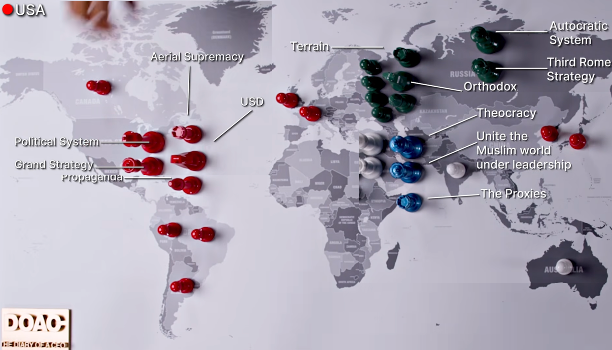
The United States — Democracy Vibrant, creative, flexible. But deeply polarised. Democrats versus Republicans. The tools America uses: air supremacy, dollar dominance, narrative control. The weakness: domestic risk tolerance. Americans — and American voters — do not like body bags. That is a real constraint.
Russia — Autocracy Coronation, decisiveness, resolve, long-term thinking. The weakness: if Putin dies, there is a succession crisis. Russia's grand strategy is the Third Rome — the first Rome fell, Constantinople fell, Moscow is the final bastion of Orthodox Christian civilisation. Aleksandr Dugin laid this out in his 1997 Foundation of Geopolitics. Unite the Christian world. Use terrain (nearly impossible to invade Russia) and Orthodox religion as twin pillars. Russia has the best land artillery in the world. Russian soldiers are not afraid to die. Russia's entry into the war:
- Reinforce Tehran via the Caspian Sea.
- Mobilise China's Belt and Road infrastructure — railways through Maymana, Mashhad — to get Chinese financing and supplies to Iran.
- Place Iran under Russia's nuclear umbrella.
Iran's foreign minister Araghchi met President Putin in April 2026. The relationship is already being activated.
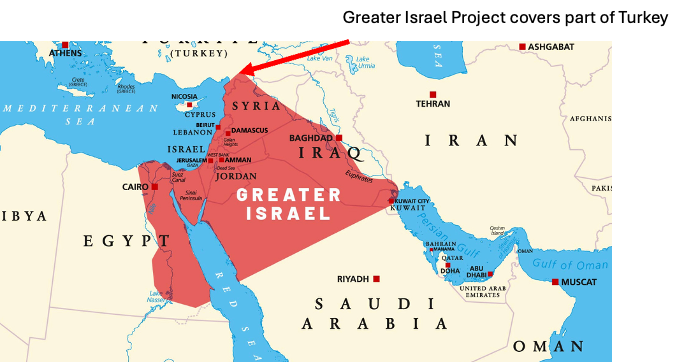
Israel — Theocracy Very creative. But divided — Tel Aviv and Jerusalem do not agree on much. Israel's strategy is Greater Israel — the belief, rooted in the Bible, that the entire Middle East from the Nile to the Euphrates is promised land. The attack vectors: Mossad, arguably the most powerful intelligence agency in the world; the Jewish Diaspora, which has close ties to Mossad and operates in business circles globally; and the Bible itself — Christian Zionists around the world support Israel and the Greater Israel project. Israelis also control a significant amount of hardware infrastructure around the world.
Iran — Theocracy As noted — the zealots are a minority. Most Iranians just want to live. But the IRGC drives the agenda. Asymmetric warfare: Hezbollah, Hamas, Houthis. Topography. Suicide bombers. Underground missiles. The Mosaic Strategy.
Here's how they will continue to fight:
- US — air power and naval blockade. Tries to avoid ground troops and casualties at all costs.
- Israel — drones. Controls straits. Attacks oil refineries.
- Russia — arm shuttle fleets. The US tries to capture Russian shadow fleets. Both are jostling for maritime influence.
And then there is the Russia–Iran support pipeline: reinforcements via the Caspian Sea, Chinese Belt and Road railways through Maymana and Mashhad providing financing and logistics, and Iran placed under Russia's nuclear umbrella.
Russia Will Win Ukraine. And Then Turn to Iran.
And after Ukraine, Russia's grand strategy connects to Iran — not just militarily, but spiritually and materially. Russians believe in humanity and community. Americans export individual nihilism. That is how Prof Jiang frames the civilisational divide, and it is a frame worth sitting with.
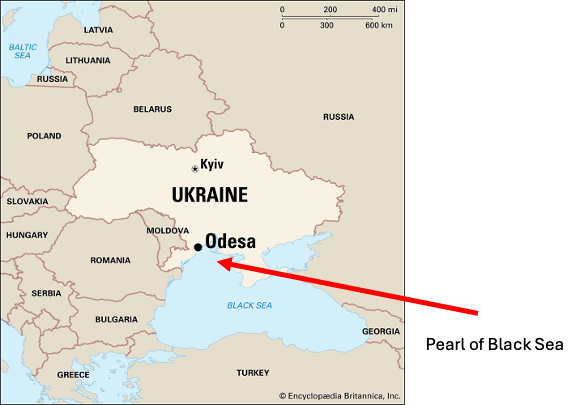
NATO and Russia will fight over Odessa — the Pearl of the Black Sea, a major port city on the northwestern shore of the Black Sea. Odessa controls roughly one-third of the world's carbohydrates. Grain. Food. Another chokepoint, another lever.
What About China?
China, interestingly, stays on the sidelines — at least officially.
Prof Jiang's prediction: China maintains friendships with both Russia and America and avoids being dragged into WW3 directly. It supports Iran quietly through financing and infrastructure. It does not become a combatant.
China's pressure points are elsewhere: Taiwan (Japan supports Taiwan), the Strait of Malacca, and the Korean Peninsula. The US has been quietly relocating THAAD (Terminal High Altitude Area Defence) components to the Middle East — which exposes South Korea to North Korean threats. Not an accident.
The Bigger Picture That Makes Your Head Hurt
Prof Jiang ends with something genuinely mind-bending.
Most of us grow up believing civilisation works like this: values and norms come first, and then systems — laws, institutions, economies — are built on top of them. We think we live in a world organised by principles.
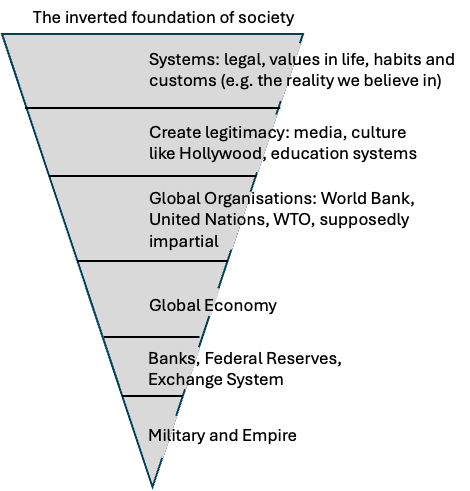
Prof Jiang inverts this. Empires and military force come first. Law, values, and habits are constructed on top of that foundation — and people forget the foundation exists. They think the values are the bedrock. They are not. They are the decoration.
When enough people realise the foundation isn't what they thought — that is when societies collapse or reform.
AI is accelerating this realisation. The old gatekeepers of narrative — governments, media, institutions — are losing their grip. Wall Street versus the tech bros. Digital IDs, programmable currencies, behavioural control baked into financial infrastructure. Your bank account could be programmed to stop you buying cigarettes. China already has this system in place. They call it progress. Whether you call it progress or control depends entirely on which side of it you are on.
Prof Jiang's Predictions, Laid Out
For the record, here is what he thinks is coming:
- 80–90% probability of World War 3. Not a single flash point. Already happening.
- Russia wins Ukraine.
- Trump runs for a third term — either by getting his son elected and then effectively taking the reins through abdication, or by invoking emergency war powers in 2028 to suspend elections entirely. America has already started a national draft from December 2026, for males aged 18–26.
- Israel achieves Greater Israel — absorbing CENTCOM's (US Central Command) role in the Middle East once the US withdraws. Israel wants to drag the war long enough to use the window to destroy other major enemies, including Turkey.
- NATO and Russia fight over Odessa — one-third of the world's grain supply.
- East Asia breaks out into conflict across three flash points: Taiwan (Japan involved), the Strait of Malacca, and North Korea versus South Korea.
- The world moves toward AI civilian states — digital IDs, programmable currencies, behavioural control in everyday financial life.
- China stays friends with everyone and avoids direct WW3 involvement.
My LOL moment - Steven's reactions
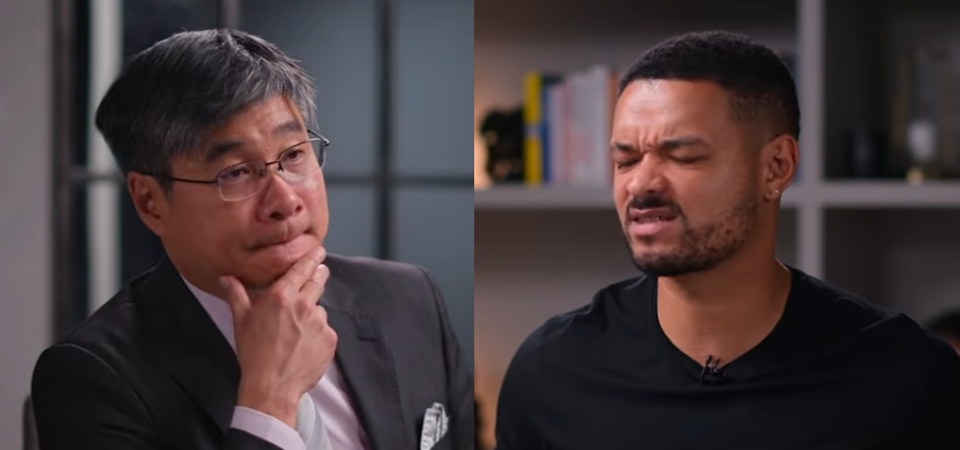
The world is not chaotic. It is playing a game most of us were never taught the rules to. I take the example when Steven was asking Jiang - are they controlling me too? It came from a place of genuine disbelief. I could tell from his reactions. He truly doesn't believe that he's being controlled. But Jiang shatters that.
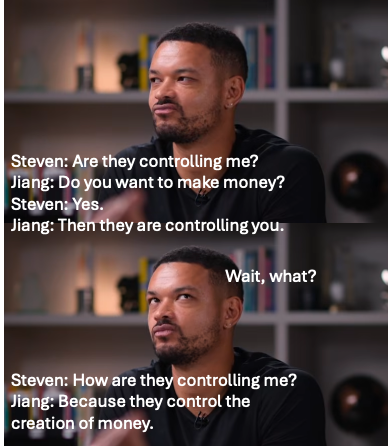
Maybe the most unsettling thing is not the war. It is the realisation that the values and systems we thought were bedrock — democracy, international law, the rules-based order — may just be the story that was told on top of something older and harder.
And that AI, of all things, might be what finally pulls back the curtain.
Source | DOAC — Prof Jiang on Geopolitics